Build vs Buy in Travel Infrastructure: A Framework, Not a Formula
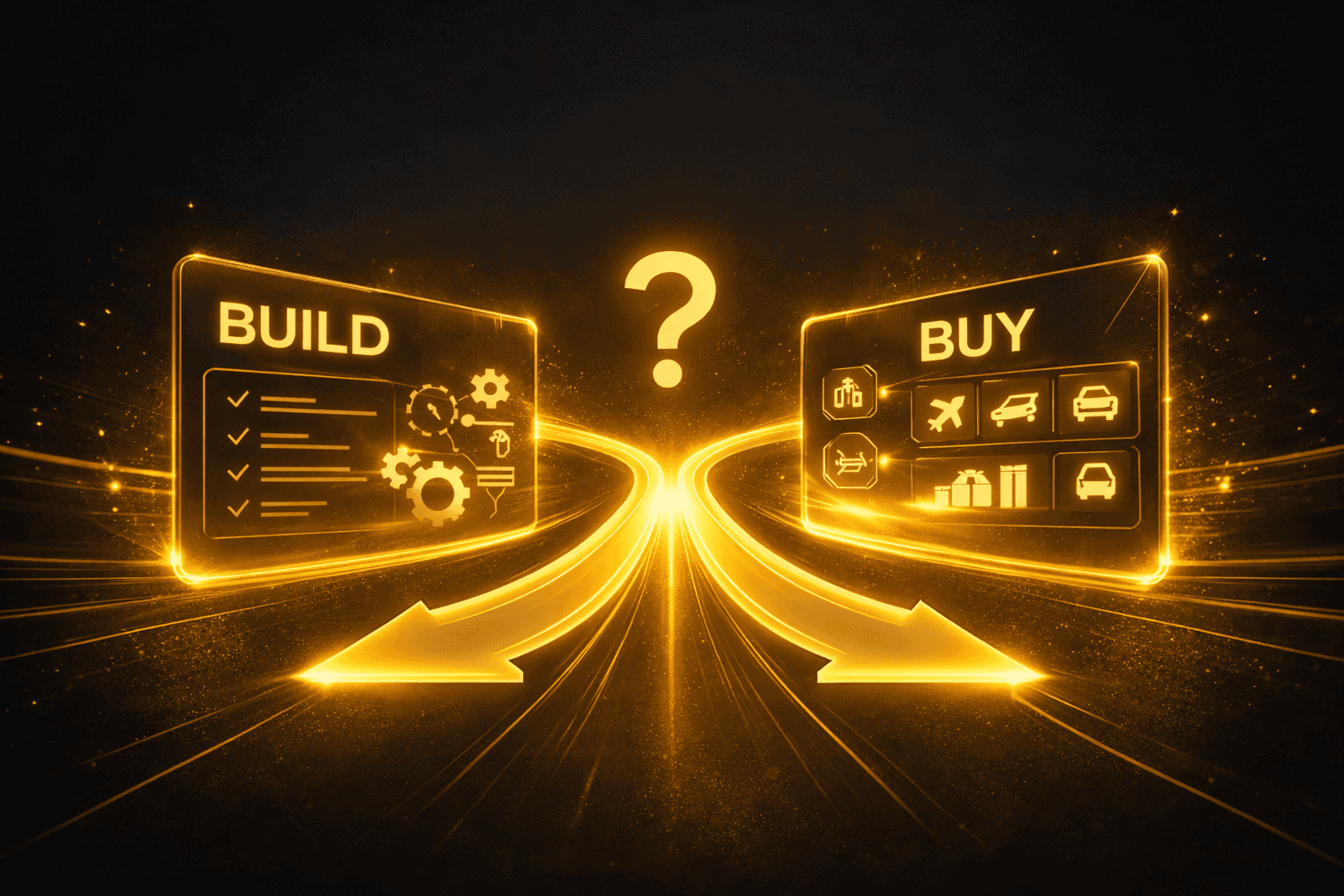
Every mid-stage travel platform debates this twice. Once when integrations start slowing them down. Again when someone suggests, "Why don't we just build this ourselves?"
The debate goes in circles. Spreadsheets appear. Control gets mentioned. Then they either build something half-finished or stay frustrated with their current setup.
The problem isn't that the question is hard. It's that most platforms ask it wrong.
The Real Question
Not "should we build?" but where does your platform compete?
If infrastructure is your moat — custom orchestration, proprietary supplier logic, unique availability routing — build it.
If your advantage is speed, coverage, or customer experience, and infrastructure just needs to work — buy it.
Most platforms are in the second category but convince themselves they're in the first.
What the Data Shows
70% of software projects exceed budgets by an average of 27%.
45% of product launches delay by at least one month.
Maintenance costs exceed 50% of total lifecycle costs.
These aren't outliers. This is the pattern.
The Budget Gap
What companies budget:
2-3 developers, 3-6 months
$150K-$250K
What it actually costs:
4-6 developers, 9-12 months
$500K-$1M initial
$300K+/year maintenance
The Technical Reality
Building hotel APIs isn't just about connecting suppliers. It's about solving problems that take years to get right:
Hotel mapping: Same property, different IDs and names across suppliers. Requires ML-powered systems maintaining 2.5M+ property mappings with 99%+ accuracy.
Room matching: "Double Room - City View" vs "Standard Room, 2 Double Beds, City View" vs "Twin/Double City View." Same room. 10,000+ variations per property to handle.
Deduplication at scale: Paris hotel search returns 6,300 listings across 3 suppliers. Actual unique hotels: ~1,500. Must identify matches, compare prices, merge content, maintain performance — in real-time.
Location complexity: "New York" search might return Manhattan only, all 5 boroughs, Newark Airport hotels, or Jersey City properties. Different suppliers, inconsistent coordinates, wrong distances, missing data.
Filter hell: "Free WiFi" appears as 5+ different strings. "Pool" could mean indoor, outdoor, seasonal, rooftop, or hot tub.
Performance pressure: Users expect sub-3-second results while querying multiple suppliers simultaneously, handling timeouts, managing caching, and reconciling dynamic pricing.
Most teams underestimate this by 3x.
Time to Market
Build: 9-12 months
Buy: 2-4 weeks
When 45% of launches delay, every month building is a month competitors are acquiring customers.
The Comparison
Metric | Build | Buy |
Time to Launch | 9-12 months | 2-4 weeks |
Year 1 Cost | $500K-$1M | $50K-$150K |
Team Required | 4-6 dedicated | 1-2 integration |
Uptime | You manage | 99.9% SLA |
Supplier Coverage | 10-20 | 100+ |
Maintenance | $300K+/year | Included |
The Framework
Build if:
Infrastructure is your competitive moat
You have exclusive supplier relationships requiring custom logic
You have 10+ experienced API developers
Speed to market matters less than control
Buy if:
You need to move fast into new markets
Your advantage is customer experience, not infrastructure
You lack focus to maintain integrations indefinitely
You value reliability and coverage over customization
Hybrid if:
You need speed now, but plan to own specific high-value suppliers later
You want infrastructure optionality without full commitment
Most platforms should start with buy, then selectively build where it matters.
The 5-Question Test
1. Is API integration your core business?
No → Buy
2. Can you afford 12+ months to market?
No → Buy
3. Do you have 10+ experienced API developers?
No → Buy
4. Do you need fewer than 5 supplier connections?
No → Buy is 10x more efficient
5. Is $1M+ investment acceptable for APIs?
No → Buy is the only viable path
Common Mistakes
Building because it feels serious. Building doesn't make you more technical. It makes you responsible for more infrastructure.
Buying without understanding tradeoffs. You're dependent on the switch's roadmap and share the same supplier pool as competitors.
Treating this as one-time. It's a spectrum. Buy for most suppliers, build direct for strategic ones. Revisit as you scale.
What This Means
Series A platform expanding into hotels? Buy. You need speed and coverage.
Late-stage platform with 50+ engineers and proprietary supplier contracts? Build. Infrastructure is your value.
Somewhere in between? Default to buy. Be strategic about which suppliers to own directly later.
The Bottom Line
Platforms waste time trying to optimize for both control and cost.
You can have control. You can have low cost. You probably can't have both in year one.
Choose what matters for where you compete. Build your strategy around that.
Everything else is noise.